

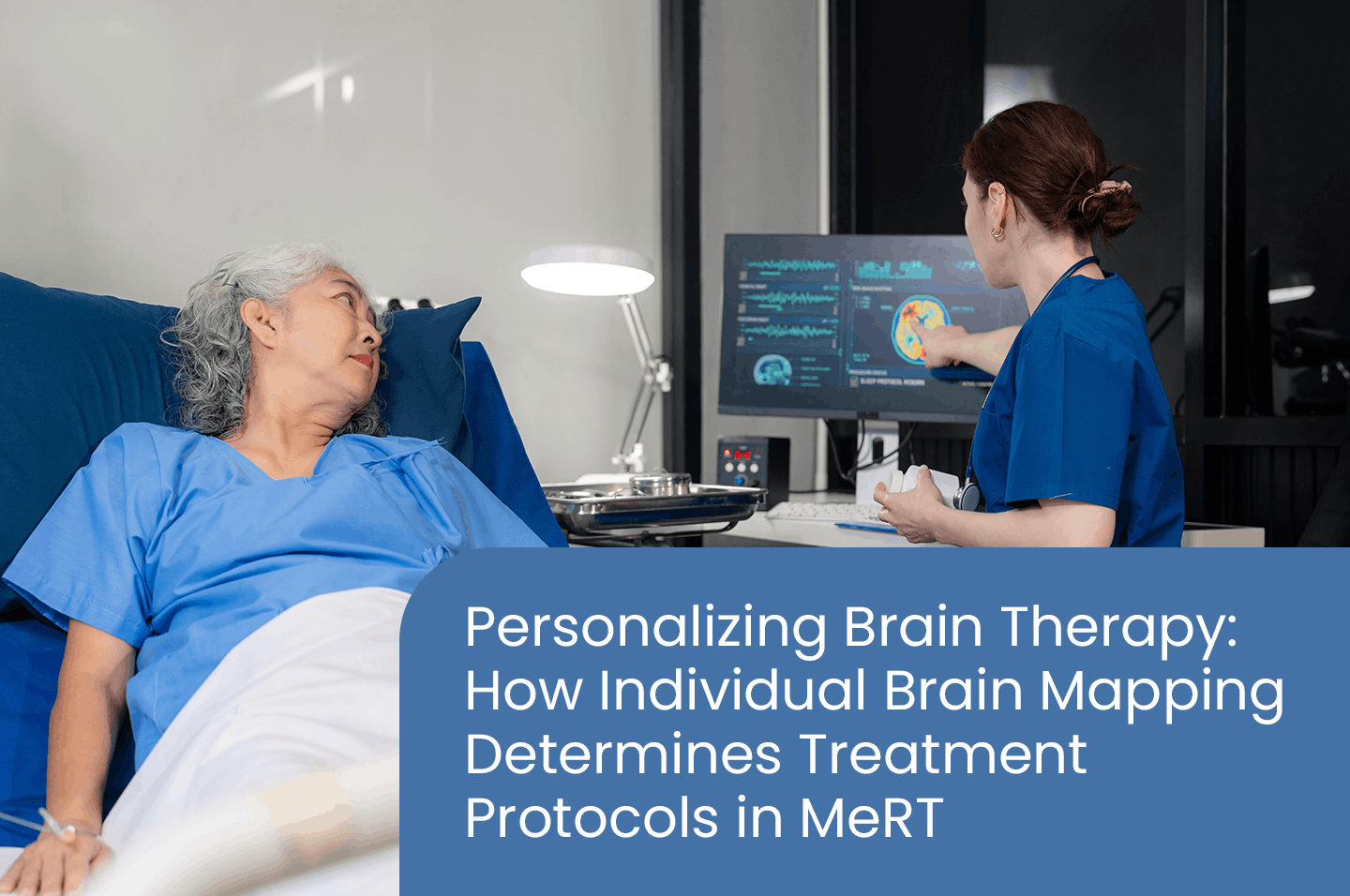
Two people seeking care for similar concerns may have different brainwave patterns, health histories, symptoms, and treatment goals. A standardized neuromodulation protocol may not reflect those differences.
MeRT, or Magnetic e-Resonance Therapy, takes a more individualized approach. At Neurosync Brain Treatment Centre, treatment planning begins with recordings of the patient’s brain and heart activity. The clinical team analyzes that information before developing a protocol specific to the individual.
Brain mapping helps guide decisions about how stimulation may be delivered and provides a reference point for later reassessment. It does not guarantee a particular result or determine by itself whether someone has a neurological or mental health condition. Instead, it gives the supervising clinical team patient-specific information to consider alongside symptoms, medical history, goals, and clinical judgment.
Before treatment begins, our published MeRT process includes a quantitative electroencephalogram, or qEEG, and an electrocardiogram, commonly called an EKG or ECG. The recordings are analyzed and used to develop an individualized treatment protocol.
This differs from beginning with the same stimulation settings for every patient. The map helps inform treatment parameters, while the broader clinical assessment helps determine whether MeRT may be appropriate.
Brain mapping supports treatment planning, but its findings must be interpreted carefully. A pattern recorded during a qEEG does not automatically confirm a diagnosis, explain every symptom, or predict how someone will respond to treatment.
A qEEG records electrical activity through sensors placed on the scalp. It is non-invasive and provides information about the frequencies and patterns present during the recording.
People sometimes refer to qEEG as a brain scan, but that description can be misleading. A qEEG measures electrical brainwave activity. An MRI or CT scan produces structural images of the brain, so the technologies provide different types of information.
Patients should follow the preparation instructions provided by the treatment centre. These directions may affect what they should do before their appointment and help the clinical team obtain a useful recording.
Recorded qEEG data can be organized into a visual brain map. This presentation allows the clinical team to examine characteristics such as the timing, frequency, and distribution of electrical activity across recorded areas.
The purpose is not to place every brain into a simple “normal” or “abnormal” category. Clinicians use the information to identify patterns that may be relevant to treatment planning and to decide which findings require further consideration.
A single pattern should not be treated as proof of a specific condition or as a reliable prediction of treatment success. Its meaning depends on the patient’s broader clinical picture.
Neurosync’s evaluation process also includes an EKG. This test records the heart’s electrical activity, including information about its rate and rhythm. It does not send electricity into the body.
Within Neurosync’s published MeRT process, the qEEG and EKG recordings contribute to an analysis that includes what the centre describes as brain-heart coherence. The information is considered as part of protocol development rather than as stand-alone proof of what caused a patient’s symptoms.
Clinical interpretation remains essential. Relationships observed in the recordings need to be considered alongside medical history, current concerns, and other relevant assessments.
After the recordings are collected, the data is analyzed before a treatment protocol is established. That protocol may guide variables such as the selected treatment location, stimulation frequency, and power or intensity.
This data-guided process is what makes MeRT a form of personalized therapy. Treatment settings are based on information recorded from the individual rather than copied from a universal template.
Patients do not choose these settings themselves. Protocol development and treatment delivery should be managed by appropriately qualified clinicians who can assess the findings, determine suitability, and supervise care.
During MeRT treatment, magnetic stimulation is delivered through a coil positioned at a designated location on the patient’s head. The individualized protocol helps guide where the coil is placed and how the stimulation is administered.
Personalization does not mean that the treatment can permanently rewire or correct the brain. It means that the clinical team uses patient-specific recordings and assessment information when selecting treatment parameters.
Experiences and responses can vary. The supervising team should explain the intended treatment approach, its limitations, and what patients may experience during a session.
An initial recording captures information from one point in time. Brainwave patterns, symptoms, medications, and the patient’s response to care may change after treatment begins.
Follow-up recording allows the clinical team to compare new information with the original assessment. The supervising clinician can then review whether the protocol should remain the same or be adjusted.
Treatment length and frequency should not be assumed in advance for every patient. Although a centre may follow a general assessment structure, recommendations and changes should be based on individual evaluation.
MeRT personalization begins with patient-specific recordings, but it does not end there. Health history, symptoms, goals, clinical findings, and response to treatment should also shape the plan.
| Treatment-planning area | Generalized approach | Data-guided MeRT approach |
|---|---|---|
| Initial settings | Uses a standard protocol | Uses patient-specific recording data |
| Stimulation location | Predetermined for the protocol | Selected using analyzed data and clinical judgment |
| Frequency and intensity | Similar settings across patients | Parameters may vary by individual |
| Reassessment | May follow a fixed plan | New information may prompt a protocol review |
An individualized protocol is not a promise of effectiveness. It also does not mean MeRT is suitable for every patient. A qualified clinical team must consider the potential benefits, limitations, health history, and other care the person is receiving.
The process generally begins with a consultation and initial recordings. Sensors are placed on the scalp to record the qEEG, while separate electrodes are used for the EKG. The collected information is then analyzed before an individualized protocol is developed.
Treatment may begin after the clinical team has reviewed the findings and determined that the patient is an appropriate candidate. Follow-up recordings can later provide new information for evaluating progress and reviewing the protocol.
Patients may find it helpful to ask:
Individual experiences and schedules may differ according to clinical recommendations. MeRT assessment and treatment also should not replace emergency care or medically necessary diagnosis and treatment from a patient’s existing healthcare providers.
Brain mapping gives the clinical team information about an individual patient’s electrical brainwave activity. When combined with EKG data, clinical history, symptoms, and professional assessment, it can guide the development and review of a personalized MeRT protocol.
The map is one part of the decision-making process. Treatment suitability, stimulation parameters, schedule, and follow-up must still be assessed individually.
Contact Neurosync Brain Treatment Centre to learn more about MeRT and brain mapping and discuss whether an evaluation may be appropriate for your circumstances.
Reach out to Neurosync Brain Treatment Centre today at +1-365-799-8438, email us at neurosyncbtc@outlook.com or click here to get in touch online.
Brain mapping in MeRT is the collection and analysis of a patient’s electrical brainwave activity to help inform individualized treatment planning.
At Neurosync Brain Treatment Centre, the published evaluation process begins with a qEEG and also includes an EKG. The resulting information is analyzed before the treatment protocol is created.
No. A qEEG records electrical brainwave activity through sensors placed on the scalp. An MRI uses magnetic fields and radio waves to produce detailed structural images.
Although people may use the phrase brain scan broadly, the two assessments measure different aspects of the brain. Patients should ask which assessment is being recommended and what information it is intended to provide.
The analyzed brainwave data helps the clinical team determine patient-specific treatment parameters. These may include the stimulation frequency, targeted location, and power or intensity.
The supervising clinical team establishes the final protocol. Patients should not attempt to select or change treatment settings themselves.
No. Neurosync describes its MeRT protocols as individually tailored using each patient’s recorded information.
Treatment parameters and schedules may differ based on assessment findings, health history, clinical judgment, and response to care. Personalization does not guarantee a specific result.
A qEEG may provide useful clinical information, but it should not be presented as a stand-alone diagnostic test for every neurological or mental health condition.
Diagnosis generally requires an appropriate clinical assessment that considers symptoms, medical history, and other relevant findings. Patients should discuss the meaning and limitations of their results with a qualified healthcare professional.