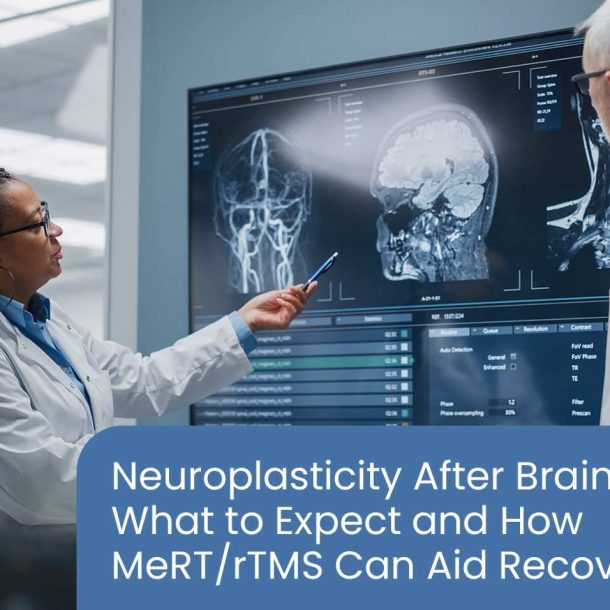

MeRT (Magnetic e-Resonance Therapy) and rTMS (Transcranial Magnetic Stimulation) are closely linked neuromodulation therapies, with MeRT building upon some of the benefits of rTMS. The differences between the two solutions are subtle, yet significant in terms of treating mental health and cognitive issues.
The deciding factor on which treatment is best depends on what condition is being treated and the surrounding factors.
MeRT is a customized neuromodulatory treatment that addresses cognitive and mental health conditions. It combines the technology from TMS, qEEG, and EKG to provide personalized treatments tailored to each person’s unique brain patterns.
The process begins with taking a resting-state electrocardiogram (ECG or EKG) and electroencephalogram (EEG), which measure your brain wave frequency, brain-heart coherence, and heart rate. Measuring and analyzing brainwave activity enables MeRT to assess the quality of communication between your brain’s neurons and to develop custom-designed treatment protocols to optimize brain functioning.
Based on preliminary findings, experts create an individualized treatment plan that serves as a guide for a TMS magnet to deliver gentle magnetic impulses targeting specific brain regions. After administering 10 treatments, EEG recordings are conducted to document your progress and provide a scientific guide for further treatments.
Since MeRT is a customized treatment tailored to a person’s unique brain structure, it can be especially revolutionary for those experiencing PTSD (post-traumatic stress disorder), insomnia, ADHD (attention deficit hyperactivity disorder), brain injury, autism, and anyone desiring to operate at peak cognitive performance.
Your brain contains over 100 billion neurons (the brain’s information messengers). Neurons use a combination of chemical signals and electrical impulses to deliver messages to places throughout your central nervous system and brain. Factors like congenital conditions, sleep disorders, addictions, chemical trauma, acute head injuries, emotional trauma, and stress can disrupt the behaviour and quality of neurons from functioning correctly.
MeRT therapy will empower you to understand your unique brainwaves, leading you to optimize your mind. Using state-of-the-art neuroimaging, MeRT treatments pinpoint which areas of your brain’s function are being disrupted. Then, it nurtures these locations to improve functioning.
By adopting a patented approach, MeRT generates a custom TMS protocol that optimizes brain synchrony. In many instances, MeRT can reshape your brainwave activity, thereby improving your cognitive performance.
By harnessing rTMS technology, MeRT’s innovative approach restores and enhances brain functioning. It provides potential benefits, such as improved concentration, better sleep, and reduced pain. MeRT aims to strengthen overall mental health and brain function by utilizing non-invasive techniques.
MeRT enhances overall brain functioning, leading to improvements in decision-making, memory, and information processing. Since treatment is non-invasive, it offers an enticing solution for those who want to improve brain health without invasive procedures or medication.
MeRT shows potential to improve cognitive functioning, offering hope for those seeking to optimize brain performance. The rTMS technology targets specific brain areas and shows promise for improving mental clarity and cognitive abilities. Patients report better mental acuity and focus, which have positively impacted their cognitive functioning.
Experts have used neuromodulatory techniques and brain imaging for decades to study brainwaves. It has allowed them to receive a better understanding of how disorders like PTSD, ADHD, insomnia, autism spectrum disorder, and more alter brain functioning.
Whether you want a better night’s sleep, improved mood, better focus or performance, or enhanced quality of life, MeRT can help you achieve transformative, long-lasting results. MeRT can also treat conditions like:
Therapy and medication are often prescribed as methods to treat mental health disorders like anxiety, depression, and OCD (obsessive-compulsive disorder). Yet, many patients still have symptoms after attempting traditional treatment methods.
Transcranial magnetic stimulation (TMS) can provide a highly effective option for people who haven’t received satisfactory improvements with their antidepressant medications, who are experiencing unwanted side effects, or who have treatment-resistant depression.
TMS works by using gentle magnetic pulses that stimulate locations in the brain associated with mood regulation. It targets areas known to be underactive in depression. TMS offers a non-invasive treatment (no surgery required) and is non-systemic (the treatment doesn’t affect your entire body).
In 2008, TMS received FDA clearance to treat depression. It also received clearance in 2018 to treat cigarette cessation and OCD. TMS can be utilized alone or in combination with other treatments, such as medication and behavioural modification.
More people are now turning to TMS to treat mental health disorders because of its fast-acting properties. It can take patients weeks to experience the full benefits of medications. Conversely, with TMS therapy, patients show symptom improvement within 2 weeks.
TMS is for people fifteen years of age and older. It has proven effective in treating major depressive disorder (MDD) with a 50%-60% symptom reduction. TMS has shown remarkable success in treating treatment-resistant depression as well. Furthermore, over 30% of people go into complete remission (that is, they do not meet the diagnostic criteria for MDD).
Its sustainable outcome is maintained using periodic maintenance sessions for long-term relief. Additional applications include:
Both forms of therapy are drug-free, non-invasive, and highly effective. Yet, there are subtle differences between the two.
Both solutions utilize magnetic stimulation to influence brain activity. However, the main difference is in how treatments are administered. TMS takes a standardized approach, targeting the same areas of the brain for all patients, whereas MeRT is based on each patient’s brain data. It targets a person’s needs using personalized protocols.
MeRT incorporates TMS, combining it with EEG recordings to offer a highly customized treatment plan that improves synchrony and functioning, targeting a variety of cognitive and mental health conditions.
Typical TMS treatments consist of 5 sessions/week for 6 weeks. Then, it drops to two sessions each week for three weeks. MeRT treatments are administered to patients from Monday to Friday. The treatment length varies according to the individual’s unique findings.
Both options are outpatient treatments. While receiving treatment, patients recline in private areas, where they can read, relax, work, or watch television. Both therapies utilize a magnet to deliver gentle impulses that stimulate targeted areas of the brain. Sessions last for 30 minutes, and once they are over, patients can immediately resume their daily activities, including returning to school or work.
When it comes time to decide which treatment method will work best for you, it is essential to consult a medical professional to help you make an informed decision. At Neurosync Brain Treatment Centre, we offer both rTMS and MeRT treatment options.
Our team prioritizes the well-being of each of our clients, understanding that every brain is uniquely wired. Our highly qualified and experienced professionals will give you a personalized treatment plan tailored to your specific needs and findings. To book an appointment, please call us at 416-473-9676, email us at neurosyncbtc@outlook.com, or complete our online form.