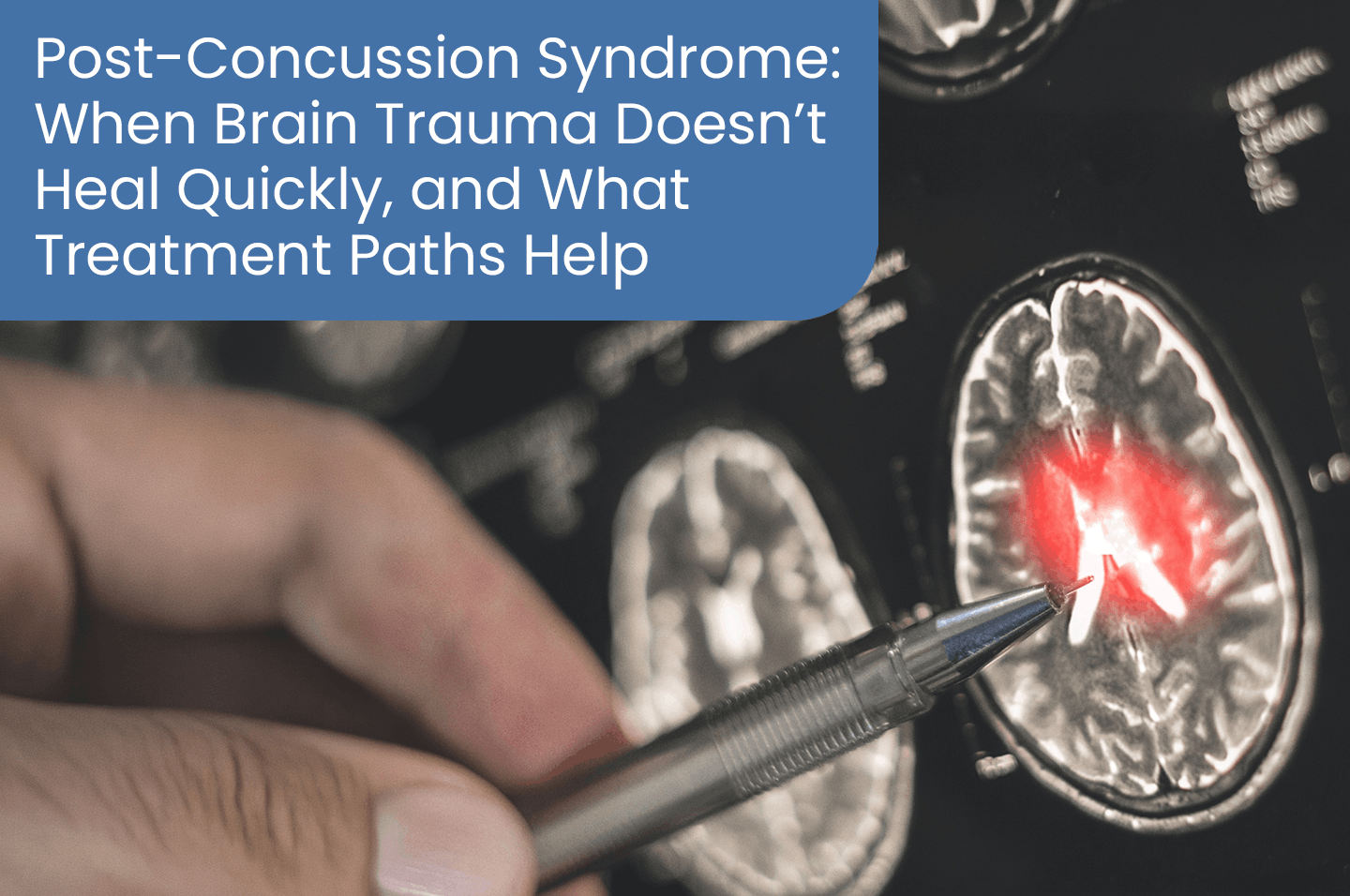
Post-Concussion Syndrome (PCS) occurs when concussion symptoms last for weeks, months, or years after your initial head injury. Generally, the recovery time for concussions is within two to six weeks. However, 13%-30% of patients may develop lasting symptoms that interfere with daily living.
Also called persistent post-concussive symptoms (PPCS), it arises when your concussion symptoms persist for longer than three months after a head injury. It can occur after any form of mild traumatic brain injury (from car accidents, sports concussions, falls, or anything that causes your brain to move rapidly inside your skull).
PCS doesn’t have to result from a loss of consciousness during brain trauma. Many people experiencing PCS do not “black out” when being injured, but can still experience long-lasting symptoms. Even experiencing whiplash or a minor bump to your head can cause PCS in certain individuals.
When a person experiences a concussion, one or several parts of the brain can be affected. Damage to an area will affect what symptoms are displayed for concussion and PCS.
There are four reasons why your symptoms may persist. These include the following:
The relationship between the blood vessels that supply the brain with nutrients and oxygen and neurons is generally the reason behind post-concussion symptoms. During an injury, your immune system immediately responds with inflammation at the location. Often, there is also damage to the area and surrounding cells.
If the cells aren’t supplied with enough oxygen to signal areas in the brain, when tasks are performed in the affected area, the person finds they are unable to complete it. As a result, other neural pathways compensate despite being less efficient in processing tasks.
Most people see improvement in their symptoms within three to six weeks after trauma. Health experts speculate that the return to normal functioning is because the brain returns to using the best processing method, or the brain compensates for the injury. However, for PCS patients, their brains continue to use less efficient methods to perform tasks after inflammation subsides.
In this case, the impacted cells either don’t receive enough blood flow to finish the task, or there is a call for too much, which makes brain functioning challenging. Other cells in close regions begin to compensate, yet it is easy for these cells to experience overload.
The vestibular system is found in the inner ear, governing things like balance and clear vision. It works by communicating your positioning to the brain. If this area is disrupted from a concussion, you may experience balance issues, dizziness, trouble with spatial awareness, sensitivity to motion, eye strain, vertigo, nausea, and sleep issues.
Your autonomic nervous system contains involuntary responses. It encompasses areas in your body like breathing, blood pressure, and heart rate. Concussions can disrupt the functioning between the sympathetic and parasympathetic nervous systems.
Concussions can impact people’s vision. Even if you have perfect eyesight, you can still have problems with your vision. Concussions often impact the way the eyes and brain communicate, generating functional vision issues.
The best thing a person with PCS can do is to physically and mentally rest. However, sometimes rest on its own may not be sufficient to ease symptoms. This is when the following alternatives become helpful:
Occupational therapy helps patients adapt to daily life while dealing with symptoms. It focuses on the injury and outside factors like mental health and environment. You will be screened for cognitive and physical symptoms to establish a treatment plan.
This approach is often used after the injury as a form of rehabilitation for the affected location. It works by getting this area used to movement again. It benefits people who have had concussions and experience headaches and/or neck pain. This method also helps with vision, dizziness, and balance challenges.
This is a type of psychotherapy that deals with your thought patterns and their effects. It benefits those experiencing emotional and mental symptoms from an injury.
This therapy repairs damage to your vestibular system after an injury. It helps those experiencing balance and dizziness issues.
As a form of massage therapy, the purpose of this method is to relieve strain in the body by focusing on fatiguing muscles and trigger points. It is known to reduce dizziness, headaches, and nausea.
Neuropsychology deals with how your brain communicates to the nervous system in relation to cognition and behaviour. Since brain injury affects different areas in the body and brain, tests are run to evaluate overall brain functioning to help experts understand how the brain is functioning and to understand the core issue.
This therapy focuses on assisting with vision-related issues. In-depth tests look at communication between the visual systems and your brain. It looks at how the injury is affecting daily tasks.
This is a non-invasive treatment wherein a person rests in a pressurized chamber with 100% pure hyperbaric oxygen for an hour. Since it gives more oxygen than normal air, it can help the body heal.
This is another non-invasive treatment to improve brain functioning. Diagnostic testing establishes which area of the brain is affected. Then, electronic devices are placed over the affected region, delivering gentle pulses to stimulate the formation of new neural connections in the brain.
We use MeRT (Magnetic e-Resonance Therapy) to stimulate areas in the brain affected by injury. Magnetic fields target, revitalize, and rebalance your brain functioning with the help of diagnostics and imaging. Our methods are safe, non-invasive, and help patients recover from symptoms by improving brain communication and connectivity with proven success.
Book your concussion treatment by contacting us at 365-799-8438, Monday to Friday between 9:00 a.m. and 5:00 p.m. You can also book your appointment online or email us at neurosyncbtc@outlook.com.