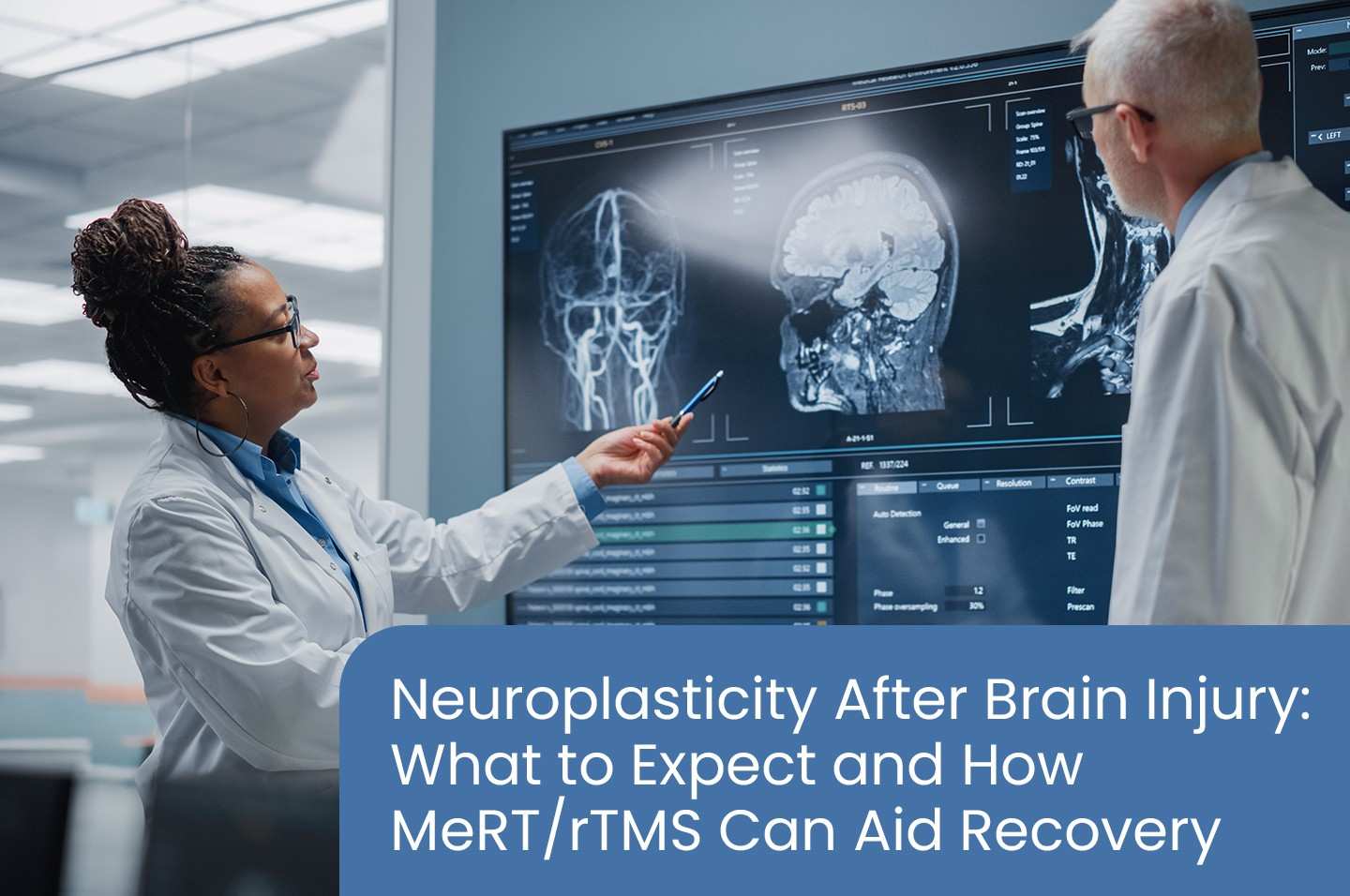
Traumatic brain injuries (TBI) happen when someone receives a sudden injury or blow to the head. It can occur from an automobile crash, a fall, or a gunshot wound and range from mild to life-threatening. While TBIs (even mild ones) can cause long-term issues, MeRT/rTMS can help restore neuroplasticity.
TBIs impact your cognitive, physical, and sensory functions. While you may wonder or even think the impact of a TBI is permanent, it may not be. The brain has a unique ability (neuroplasticity) to reorganize itself and form neural connections after experiencing injury.
The good news is that MeRT (Magnetic e-Resonance Therapy) and TMS (Transcranial Magnetic Stimulation) can foster brain healing and improve your overall health.
After a TBI, neural connections can be lost or damaged, resulting in impaired speech, movement, memory, and other essential functions. Neuroplasticity involves your brain’s ability to rewire, adapt, and create new neural pathways as a response to new learning or injury.
Physically, neuroplasticity is your brain’s ability to reorganize and form synaptic connections as a response to experience, learning, or following an injury. If you are a patient, it is your brain’s ability to heal after a TBI when the correct external stimuli are applied.
Many people with a TBI show dysfunction in their neurovascular coupling (NVC) pathways. This dysfunction can arise from a single or a series of concussions, viral/bacterial infections, transient ischemic attack, carbon monoxide poisoning, long COVID-19, and other factors.
NVCs are connections between your neurons and blood vessels that supply them with oxygen. Healthy connections generate electrical and chemical signals calling for oxygen when a process requires completion. The neural response is that more blood flows to your gray matter.
NVC is a dynamic, extremely delicate process. Even minor alterations in communication between blood vessels and neurons can impair brain function. Damaged areas can disrupt communication between blood vessels and brain cells. There are times when the brain may ask for too little oxygen while performing a task, while at other times, the opposite occurs.
The result is an overtaxed system, causing your brain to burn out quicker, thereby generating cognitive impairment.
The proper therapy can help neuroplasticity in affected neural networks. When properly applied, it allows the brain to correct its signalling. It will enable your brain to use the right area for the correct process, in the appropriate way.
When recovering from a TBI, the right therapy will help to:
Repetitive Transcranial Magnetic Stimulation (rTMS) uses short magnetic pulses that activate your brain’s nerve cells. This non-invasive brain stimulation is FDA-approved and can be used to treat TBI.
Several studies have examined the effects of TMS to treat TBI. In a study of patients starting on May 19, 2020, rTMS was effective in treating post-concussion symptoms. Furthermore, additional research appears to confirm this conclusion.
After a TBI, the main objective of rehabilitation can be motor recovery. With rTMS, we can send impulses to a brain region using different intensities/frequencies. It alters neural plasticity and activity to enhance motor function.
TBIs can also affect emotional and cognitive functioning (memory impairments, executive functioning, attention span, emotional regulation, and cognition). TMS measures cortical excitability and interhemispheric responses of the emotional and cognitive systems following a traumatic brain injury.
MeRT is Magnetic e-Resonance Therapy, which is a highly customized form of TMS. By combining rTMS with quantitative electroencephalogram (qEEG) and electrocardiogram (ECG/EKG) recordings, physicians can identify and treat dysfunctional brain regions.
MeRT combines all the diagnostic methods mentioned above to analyze results and form treatments tailored to the person’s unique brain patterns.
TMS typically provides stimulation to a single brain area at fixed frequencies for each patient. Meanwhile, MeRT offers a tailored, scientific approach that differs with each patient.
With this treatment, we analyze your results to identify patterns in your brain’s activity and function. By using detailed analysis, we can plan for proper neural synchronization. We then create a personalized plan to encourage brain communication. Most patients report significant improvement after treatment.
The benefits of both treatments are as follows:
Regarding TBIs, the advantages for patients include:
These treatments may not be right for every individual. You should not consider them if you have the following:
A brain injury can cause long-term complications. However, thanks to the brain’s neuroplasticity, recovery can be possible.
If you were diagnosed with a TBI, then MeRT and TMS can improve your quality of life. At Neurosync Brain Treatment Centre, we can help you determine whether these options are right for you with our highly customized treatment plans tailored to your needs.
Call us at 416-473-9676, email us at neurosyncbtc@outlook.com, or fill out our online form to see how we can help you.